
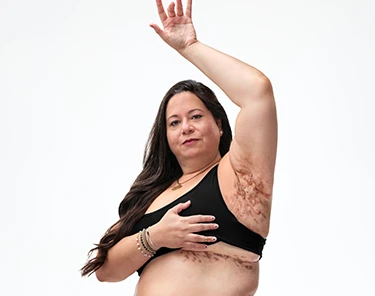
HS is a complex condition driven by immune system dysregulation, with multiple proinflammatory cytokines contributing to its pathogenesis.1 The clinical presentation may also vary from person to person, making it challenging to manage.2
Gaps in today’s HS care experience
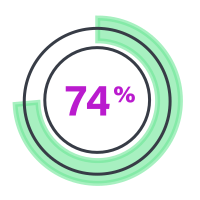
74% OF PATIENTS WITH HS WERE UNAWARE OF FDA-APPROVED TREATMENTS
and over half hadn’t discussed them with their doctor3
82% OF PATIENTS WITH HS REMAIN UNSATISFIED WITH THEIR CURRENT TREATMENT OPTIONS3
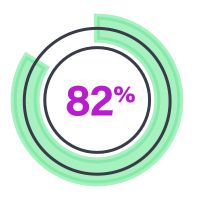
Based on 423 surveys completed by adults with HS between November and December 2023.3
Current treatments

While current treatments like conventional systemic therapies (eg, antibiotics, retinoids) and surgical interventions offer some relief, they do not address the inflammatory drivers of HS.1,4

Currently approved biologics target specific cytokines, such as TNF-alpha and IL-17, to address inflammation.1
In addition to TNF-alpha and IL-17, there is a range of proinflammatory cytokines involved in the pathophysiology of HS. The JAK-STAT pathway transmits some of the signals of these cytokines within the immune cells, driving HS.5

“We actually have people who are doing basic science research, trying to help create more treatments. It's a breath of fresh air in a space that really needed it.”
FDA, Food and Drug Administration; HS, hidradenitis suppurativa; IL-17, interleukin 17; JAK-STAT, Janus kinase–signal transducer and activator of transcription; TNF, tumor necrosis factor.
REFERENCES: 1. Sabat R, Alavi A, Wolk K, et al. Hidradenitis suppurativa. Lancet. 2025;405(10476):420-438. doi:10.1016/S0140-6736(24)02475-9 2. Zouboulis CC, Benhadou F, Byrd AS, et al. What causes hidradenitis suppurativa? — 15 years after. Exp Dermatol. 2020;29(12):1154-1170. doi:10.1111/exd.14214 3. Murdock A, Whiting C, Azim SA, et al. The state of the clinical management union: a cross-sectional survey of persons with hidradenitis suppurativa. J Drugs Dermatol. 2025;24(4):381-385. doi:10.36849/JDD.8867 4. Alikhan A, Sayed C, Alavi A, et al. North American clinical management guidelines for hidradenitis suppurativa: a publication from the United States and Canadian Hidradenitis Suppurativa Foundations: part II: topical, intralesional, and systemic medical management. J Am Acad Dermatol. 2019;81(1):91-101. doi:10.1016/j.jaad.2019.02.068 5. Wolk K, Join-Lambert O, Sabat R. Aetiology and pathogenesis of hidradenitis suppurativa. Br J Dermatol. 2020;183(6):999-1010. doi:10.1111/bjd.19556